
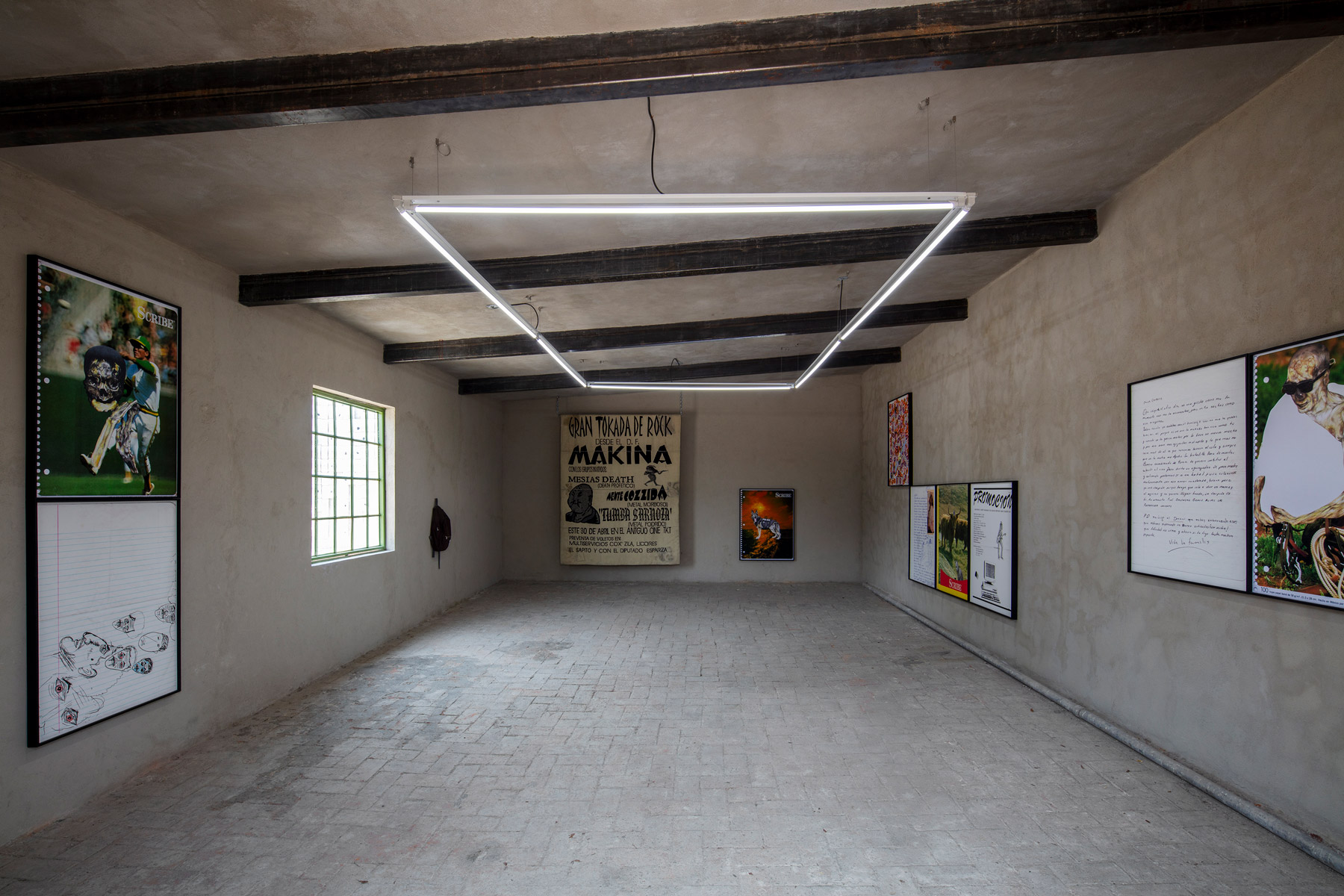
I remember using this kind of notebooks: professional spiral bound, Italian hardcover, and French with small grid. In one of them I must have written a reading report about that “ancient world,” that “strange country called the past” where once a handful of pre-pubescent chilanguillos staged distant sectarian battles in the schoolyard at recess time. Unlike José Emilio Pacheco’s novel, the school notebooks that serve as the basis for this exhibition, recover a much more arid, atrocious, and sordid emotional panorama. Here, the children have been in their teens for quite some time, and the battles do not refer to remote places far from the national territory but to the daily life of the northern border. Far from the nostalgia and longing with which Pacheco described those “new forms of consumption” that would bring progress and happiness, Cristian Franco (Tecate, MX _ 1980) works from the hangover of a decaying dream where progress never germinated and government propaganda—along with its pathetic attempt for fraternity—is unmasked by the corrosion of everyday life… post data: Long live the family!
“They scratched his notebooks,” that’s what they used to say in my school when someone interfered in someone else’s personal life, leaving a trail of sullied affections in their wake. The scratching was often not just metaphorical. Some- times someone would find his notebook intervened by the “creations” of some small-time Hitler. The strokes on the paper would inevitably end up in garbage, but they would leave behind an indelible trace in the spirit of the victim. Drawn at the surface of the skin, this intervention inscribed as a prison tattoo in the subconscious, is also a meeting point. In those strokes, there are crude and coarse gestures—a kind of intimacy that is taking root. A novice and immature intimacy, once and a thousand times crossed out, amended and spoiled again, but above all shared. Perhaps there is a friendship that is like a shared garbage dump. An open-air landfill where the boundaries of fraternity are redrawn daily and the leftovers of abuse slowly sediment a relationship in which the survivors of the hormonal hecatomb recognize each other. Is this a twisted sort of emotional education? Processes and affective systems that happen in the margin of a notebook, on the fringes of institutional learning.
Then there is the memorable Panamanian fighter Roberto “Manos de Piedra” Durán, whose devastating punch undermined opponents, particularly when the champion worked the soft zones with quick exchanges at close range. Duran possessed a lethal combination of footwork and evasive agility that he took full advantage of to surprise anyone who got in his way. The presence of “Manos de Piedra” in this space is no coincidence. His is not a metaphor, is an analogy. His iron punch and relentless attack were matched only by his stubbornness and endurance. He was a real brawler who learned to dodge the blows to surgically plant his hands of stone at will.
The battles in the ring or in the imagined desert of the schoolyard are dwarfed by the bloodiest and also the most mundane of battles; those that are fought in the density of that jungle of affections called puberty. Battles anchored in the moorings of popular culture: from Walt Disney’s “Treasures of Knowledge” to animated fantasies, passing through the covers of the eternal Scribe hardcover notebooks, bestiality disguised as immaturity makes its way and the infantile beasts are hungry, a cannibalistic hunger.
I interpret the work gathered in this exhibition as an exercise of affective pocket-sized speleology. There is no exact science in this excavation, but there is a methodology. With cold blood, Cristian Franco delves into the cavernous pits of friendship, into the depths of adolescent restlessness, and into the eternal social immaturity, brutal and invasive, which never seems to mature.
To laugh or cry, tear the sheet and throw it in the trash? Burn it if possible, make it disappear at all costs. Turn the page and move on with life. Who would be necrophiliac enough to keep such aberrations? In whose head is it possible to make them public, 25 years later?
Text: Eduardo Thomas
Translation: Diego del Valle


